
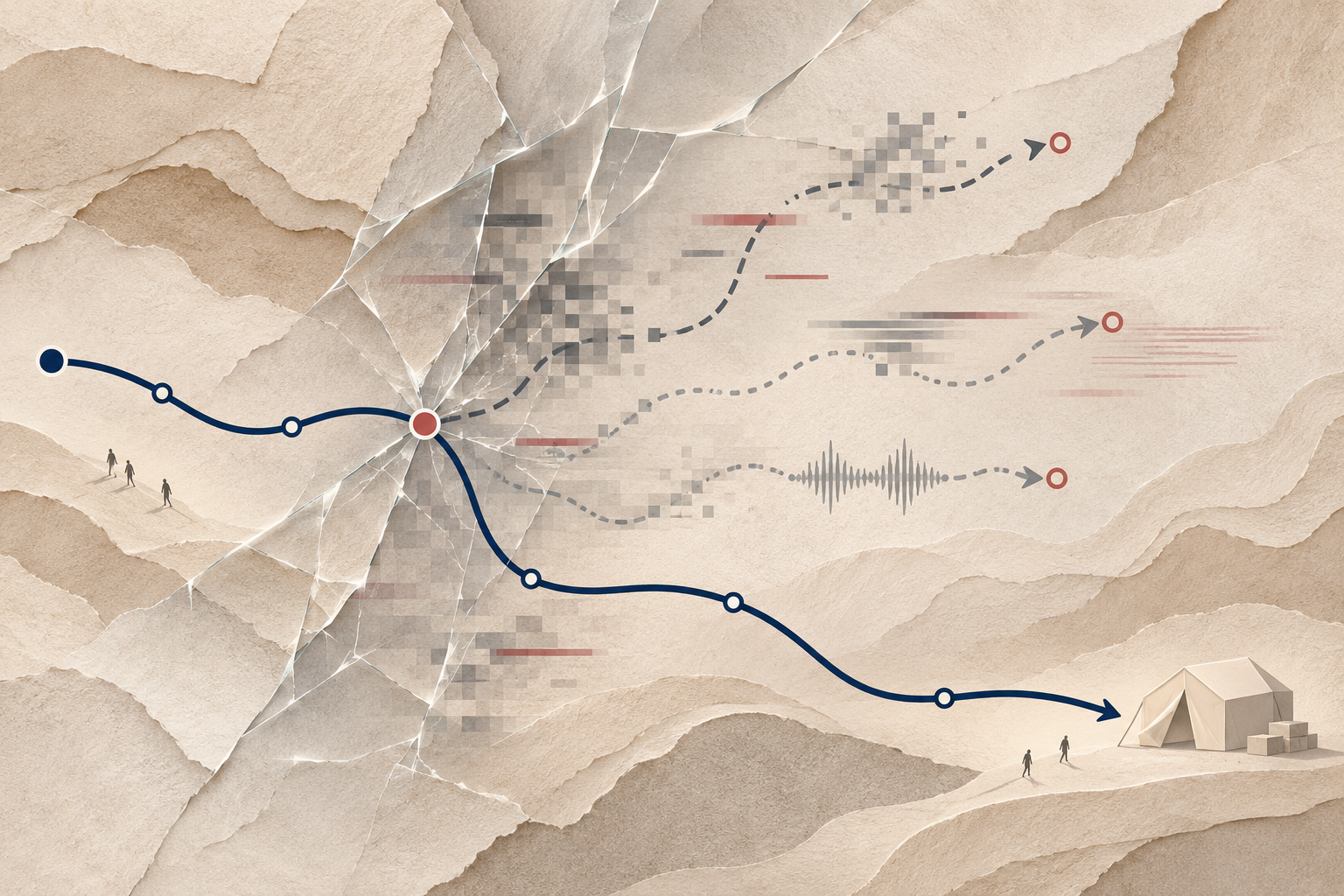
Armed conflicts have always been accompanied by harmful information. Today, however, advances in artificial intelligence are making it easier to produce and distribute convincing synthetic content, commonly known as deepfakes. These technologies operate within a wider information environment shaped by misinformation, disinformation, and malinformation, each of which can influence civilian behavior, humanitarian operations, and conflict dynamics.
In this article, Tural Akhundov, Research Fellow at CRESCENT Research Center, argues that deepfakes should be understood as a new accelerator of information harms rather than a standalone phenomenon. By amplifying misinformation, enabling sophisticated disinformation campaigns, and increasing the harmful use of authentic information, deepfakes can undermine civilian protection, humanitarian access, and accountability during armed conflict.
Understanding the Information Threat Landscape
Before examining deepfakes, it is important to distinguish between three related but different forms of harmful information:
1. Misinformation refers to false information shared without the intention to deceive. For example, during conflict, a civilian might unknowingly share an inaccurate evacuation route or an outdated security warning, believing it to be true.
2. Disinformation refers to false information deliberately created or disseminated to mislead. State actors, armed groups, or other actors may intentionally spread fabricated content to manipulate public opinion, undermine trust, or influence military and political outcomes.
3. Malinformation differs from both. It involves genuine information that is used to inflict harm. Examples include publishing personal information about aid workers, exposing the location of civilians seeking shelter, or circulating authentic images words, or sentences outside their original context to incite violence.
These distinctions matter because the humanitarian consequences often arise not from whether information is true or false, but from how it affects people and decisions. Thus, today deepfakes enter this landscape as a powerful new tool capable of accelerating all three forms of information harm and they are no longer a futuristic concern.
Today, artificial intelligence can generate realistic videos, images, and voices that are difficult to distinguish from authentic content. During armed conflicts, where information is already fragmented and contested, such technologies create new risks for civilians and humanitarian actors alike and the central challenge is not simply that people may believe false information, it is that deepfakes undermine confidence in all information. When authentic evidence can be dismissed as fabricated and fabricated evidence can be presented as authentic, trust itself becomes a casualty of war. This matters because humanitarian action depends on trust. Civilians need reliable information to make life-or-death decisions while humanitarian organizations depend on credibility to gain access to affected populations. Moreover, investigators rely on digital evidence to document violations and so deepfakes threaten each of these functions.
Deepfakes as a Force Multiplier
Deepfakes are best understood not as a separate category of information harm, but as a technology that can magnify existing ones. They can contribute to misinformation when synthetic content is shared by individuals who mistakenly believe it is authentic. A fabricated video of an attack, for example, may spread rapidly through communities seeking urgent information. They can also serve as powerful instruments of disinformation when actors intentionally create and distribute synthetic media to deceive audiences. A falsified statement attributed to a military commander or political leader could provoke panic, encourage displacement, or fuel retaliatory violence.
Deepfakes may also facilitate malinformation. Authentic photographs, recordings, or documents can be manipulated, selectively edited, or combined with synthetic content to increase their harmful impact. In such cases, the information itself may be genuine, but its presentation is designed to inflict damage. Research from the Massachusetts Institute of Technology found that false information spreads faster and reaches more people online than truthful information and the rise of generative artificial intelligence risks accelerating this trend by making persuasive synthetic content easier and cheaper to produce.
This having said, for humanitarian actors, the concern is not only the spread of falsehoods but the growing difficulty of determining what information can be trusted during moments when accurate information is most critical.
The Threat to Humanitarian Operations
Humanitarian organizations increasingly operate in digital information environments as they use online platforms to communicate with affected communities, coordinate relief efforts, and provide public information, and this is where deepfakes introduce new vulnerabilities. Today, it is very easy for instance, to fabricate a video falsely depicting humanitarian workers favoring one side of a conflict. Never before we had a situation when an AI-generated audio message could imitate aid officials and disseminate dangerous instructions. Perceptions of neutrality, independence, or impartiality, all are subject to undermining activities with the use of false content.
These risks are particularly acute because humanitarian organizations rely heavily on trust and once confidence is eroded, rebuilding it can take months or years. In some contexts, misinformation campaigns may even endanger humanitarian personnel by increasing suspicion among local communities or armed actors. The concern is not hypothetical. Humanitarian organizations have already faced coordinated online disinformation campaigns, although the growing sophistication of generative AI is making such operations more convincing and more difficult to counter.
Documentation of Violations & Civilian Protection Issue
Another challenge concerns accountability. fabr images and videos have become increasingly important in documenting violations of international humanitarian law and human rights abuses. Open-source investigations now routinely rely on publicly available visual evidence and deepfakes complicate this process in two ways.
First, fabricated content may contaminate evidence-gathering efforts and divert investigative resources. Second, authentic footage may be dismissed as fake – a phenomenon scholars describe as the “liar’s dividend.” In other words, the existence of deepfakes can provide plausible deniability for those seeking to reject genuine evidence and the result is a growing burden on investigators, journalists, courts, and humanitarian organizations to establish authenticity.
The humanitarian consequences of deepfakes extend beyond information integrity, they directly affect civilian protection. Conflict-affected populations often rely on digital information to determine safe routes, identify humanitarian assistance, locate family members, or assess security risks. False information can interfere with each of these decisions. Imagine a fabricated evacuation order directing civilians toward unsafe areas, or an AI-generated warning of an imminent attack that triggers unnecessary panic and displacement. Such scenarios are increasingly plausible as generative AI tools become more accessible.
From a humanitarian perspective, the key issue is not whether deepfakes are technically sophisticated. It is whether they can contribute to harm and unfortunately in many contexts, the answer is increasingly yes.
What Should Humanitarian Actors Do?
Although humanitarian organizations cannot solve the deepfake challenge alone, there are several steps worth considering. First, organizations should strengthen digital verification capacities and invest in tools that help authenticate visual and audio content.
Lukas Andriukaitis, Co-Founder of Civic Resilience Initiative, in his interview to CRESCENT Research Center, has stressed:
“The Middle East crisis has made this brutally clear. Content inciting violence reaches millions before any coordinated response is even drafted. Definitions of incitement vary so widely across jurisdictions that bad actors simply route their operations through the most permissive ones. And platform-by-platform self-regulation has consistently failed: Telegram remains a near-ungoverned space for extremist coordination, and smaller platforms operate with effectively no accountability.”
Second, humanitarian actors should expand digital literacy initiatives for affected communities, as helping people evaluate information critically may become as important as providing information itself. Third, discussions about civilian protection should increasingly include information integrity. Just as humanitarian actors consider threats to physical infrastructure, they should also assess risks to the information ecosystems upon which civilians depend. Finally, governments, technology companies, researchers, and humanitarian organizations should collaborate on standards and safeguards that reduce the malicious use of synthetic media in conflict settings.
Conclusion
The humanitarian consequences of war are often measured in casualties, displacement, and destruction. Yet conflicts also damage something less visible: trust. Misinformation, disinformation, and malinformation each contribute to this erosion in different ways.
Deepfakes intensify the challenge because they make harmful information more convincing and authentic information easier to contest. As a result, civilians, humanitarian organizations, journalists, and investigators may find it increasingly difficult to distinguish truth from manipulation.
As artificial intelligence continues to transform the information landscape, humanitarian actors will need to address not only the technological challenge of deepfakes but the broader ecosystem of information harms in which they operate. This having said, protecting civilians in the digital age may increasingly depend on protecting the integrity of the information upon which their safety, decisions, and survival rely.
No comment yet, add your voice below!